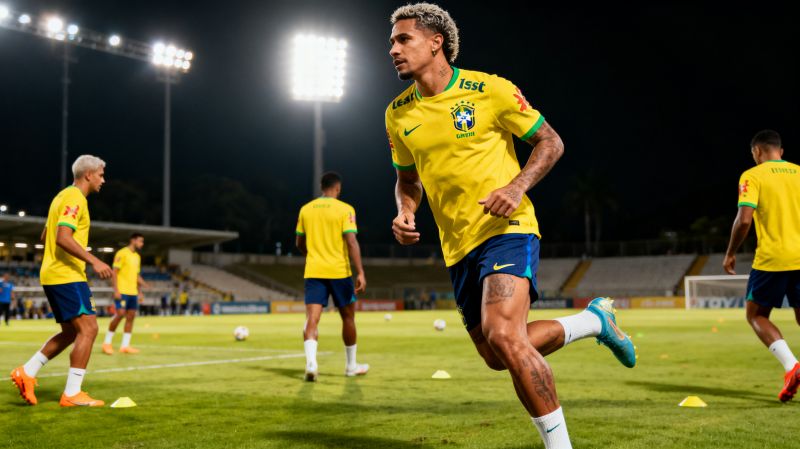
Brazil's starting lineup rarely stays identical for long, and that instability is the point. In a 4-2-3-1 that morphs into a 4-3-3 out of possession, the Seleção's shape depends less on a fixed eleven than on which version of the front four shows up. Watch the warm-up: the two holding midfielders rehearse diagonal switches while the fullbacks sprint into the half-spaces. That drill tells you more about Brazil's starting lineup than any press conference.The back line picks itself defensively but not stylistically. Marquinhos and Gabriel Magalhães form a center-back pairing that prefers to defend on the front foot, stepping into midfield rather than retreating. That aggression creates a chain reaction: the holding pair must cover wide zones, and the fullbacks—often wingers by trade—are asked to tuck in during buildup. When Brazil's starting lineup includes both Danilo and Wendell, the build-up becomes conservative;
swap in Vanderson or Caio Henrique。and the tempo jumps. I've counted at least six different fullback combinations in the last twelve months. None felt settled.The midfield pivot is where Brazil's starting lineup gets genuinely interesting—and fragile. Bruno Guimarães anchors with an upright posture and a quick release, but his partner changes the team's entire risk profile. Pair him with João Gomes, and you get a ball-winner who covers ground but rarely breaks lines. Pair him with Douglas Luiz, and the passing range expands。though the counter-press loses a beat. Lucas Paquetá drifts between the lines as a nominal No. 10, but his real value is in occupying the left half-space so Vinícius Júnior can isolate the right back. That asymmetry is deliberate. It also means Brazil's starting lineup leans heavily on one flank;shut down Vinícius, and the right side—often Raphinha cutting inside—becomes predictable.Up front, the No. 9 question refuses to die. Richarlison offers pressing and chaos;Gabriel Jesus links play but drifts wide;
Endrick is a wildcard who plays like every touch is a final. Brazil's starting lineup has cycled through all three in competitive matches。and the choice shapes the press. With Richarlison, Brazil defends in a 4-4-2 mid-block. With Jesus, the front line rotates more fluidly but wins fewer second balls. I'd argue the real starter is whoever matches the opponent's center-back pairing—a pragmatic, almost reactive selection that frustrates fans hoping for a fixed identity.Brazil's starting lineup is less a blueprint than a negotiation between talent and structure. The individual quality is undeniable;
the collective balance is still being argued over in real time. That's not a weakness to fix overnight—it's the condition of a team with too many creators and too few destroyers. The next friendly will tell us whether the coaching staff trusts the double pivot or blinks again. My hunch?They blink. Brazil's starting lineup will look different by kickoff—and that's the most honest thing about it.